Air Fryer Chicken Tenders: Crispy, Juicy in 20 Min
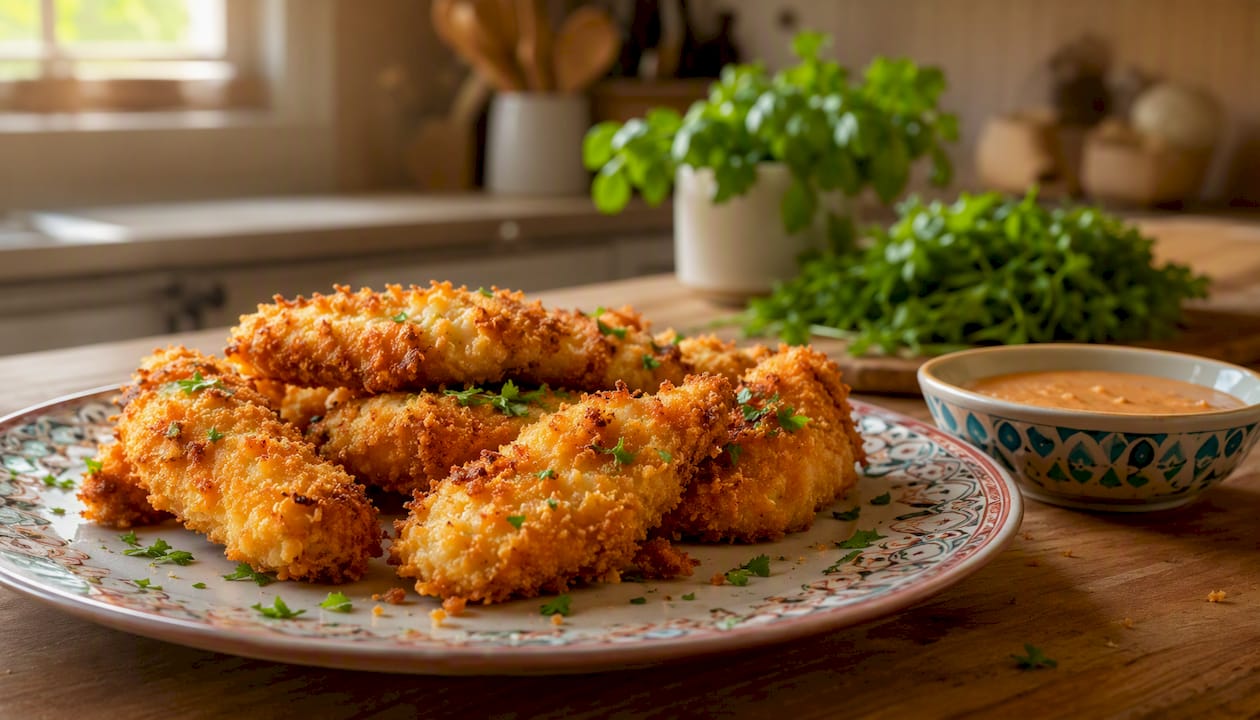
Cook air fryer chicken tenders at 400°F for about 10 minutes total (flip once at the 5-minute mark) and pull them the moment an instant-read thermometer reads 165°F — the USDA’s minimum safe internal temperature for poultry. Rest them 2–3 minutes before serving. That’s the whole recipe in one sentence.
A few quick clarifiers before you start:
- Breaded (panko) tenders: about 10 minutes total at 400°F, flip once halfway. Spray with oil before cooking and once at the flip.
- No-bread tenders: about 10 minutes total at 400°F, same flip timing. Coat in seasoned oil or a spice rub instead.
- Frozen tenders: cook longer at 400°F, flipping once midway, no thawing needed.
- Safety check: Always verify internal temperature reaches 165°F at the thickest part. Rest 2–3 minutes for carryover heat to finish the job.
- One tool you need: An instant-read thermometer. Everything else is optional.
The whole process, including breading, runs 20–30 minutes start to finish. It’s faster than the oven and less messy than a deep fryer.
Key Takeaways
Air fryer chicken tenders cook at 400°F for about 10 minutes total, reach a safe internal temperature of 165°F, and deliver a crispy panko crust with significantly less oil than deep frying.
| Point | Details |
|---|---|
| Cook temp and time | 400°F for 10 minutes total (fresh); 12–15 minutes for frozen. Flip once at the halfway mark. |
| Safety temperature | Pull at 165°F internal temp (USDA standard); rest 2–3 minutes before serving. |
| Crispness tip | Use panko, spray oil before and at the flip, and rest breaded tenders 5–10 minutes before cooking. |
| Reheating leftovers | Air fryer at 375°F for 3–4 minutes restores crispness; reheat to 165°F before eating. |
| Hearthlyrecipes | Tested air-fryer chicken recipes with step-by-step instructions are available in the air fryer collection. |
Table of Contents
- What goes into air fryer chicken tenders?
- Do you have the right equipment?
- How to cook chicken tenders in an air fryer
- Quick timing and temperature reference
- Flavor variations and dipping sauce ideas
- How to store and reheat leftover tenders
- Nutrition estimate per serving
- How we tested this recipe
- Common problems and how to fix them
- Why this recipe earns a permanent spot in your weeknight rotation
- More tested air fryer recipes from Hearthlyrecipes
- Useful sources
- FAQ
What goes into air fryer chicken tenders?
Two approaches, two short ingredient lists. Pick the one that fits your night.
Breaded version (panko)
Serves 4 (about 8–10 tenders, roughly 1.5 oz each before cooking).
- 1.5 lbs chicken tenderloins (or chicken breast cut into strips)
- ½ cup all-purpose flour
- 2 large eggs, beaten
- 1 cup panko breadcrumbs
- 1 tsp garlic powder
- 1 tsp smoked paprika
- ½ tsp onion powder
- ½ tsp salt, ¼ tsp black pepper
- Cooking spray (avocado or olive oil)
No-bread version (seasoned oil)
- 1.5 lbs chicken tenderloins
- 2 tbsp olive oil
- 1 tsp garlic powder, 1 tsp paprika, ½ tsp cumin
- Salt and pepper to taste
Optional marinade upgrade: Swap the olive oil for ½ cup plain Greek yogurt mixed with the same spices. A yogurt marinade tenderizes the meat at the surface and helps spices cling better. Even 30 minutes in the fridge makes a difference; overnight is noticeably better.
Common substitutions
| Original | Swap | Notes |
|---|---|---|
| All-purpose flour | Rice flour or GF flour blend | Keeps the dredge gluten-free |
| Panko breadcrumbs | GF panko or crushed cornflakes | Same crunch, no gluten |
| Egg | Aquafaba (3 tbsp) | Vegan binder, works well |
| Olive oil | Avocado oil spray | Higher smoke point |
| Regular panko | Low-sodium panko | Cuts sodium by roughly half |
| Smoked paprika | Lemon-pepper seasoning | Bright, citrusy profile |
Do you have the right equipment?
You don’t need much, but a couple of items genuinely change the result.
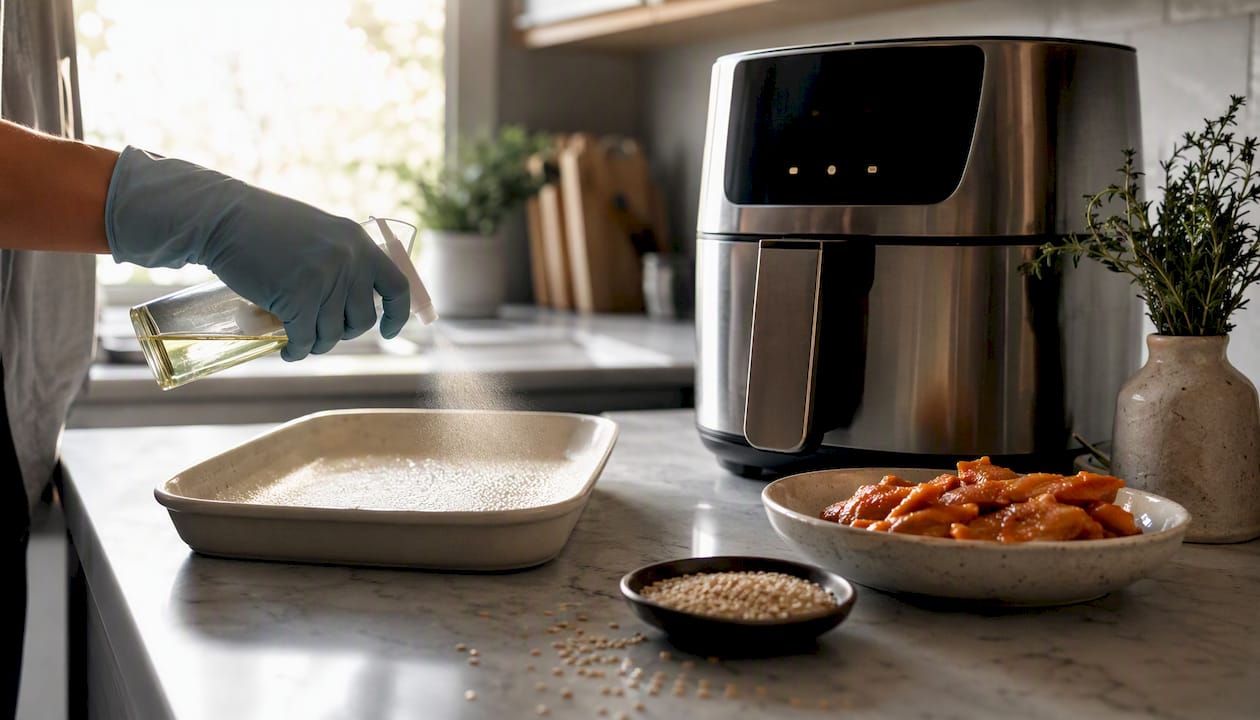
Air fryer size: A 3.5-quart basket fits about 6–8 tenders in a single layer. A 5–6-quart model handles 10–12. Single-layer cooking is non-negotiable for crispness — stacking tenders traps steam and turns the coating soft. If you’re feeding more than four people, cook in two batches rather than crowding.
Essential tools:
- Instant-read thermometer (a Thermapen or any fast digital model): the only reliable way to hit 165°F without guessing. An instant-read thermometer positioned in the thickest part of the tender is the surest way to avoid overcooking.
- Oil mister or cooking spray: a light, even coat is what turns panko golden. A quality oil mister gives you more control than a pressurized can.
Basket vs. tray: Basket-style air fryers circulate heat from below and around the food, which tends to brown the bottom faster. Tray-style (oven-type) models may need an extra minute or two. Parchment liners with holes are fine for no-bread tenders; skip them for breaded ones since they can block airflow under the coating.
Pro Tip: Preheat your air fryer for 3–5 minutes before adding tenders. A cold basket adds 2–3 minutes to cook time and produces a paler, softer crust.
How to cook chicken tenders in an air fryer
Fresh breaded tenders
- Pat tenderloins completely dry with paper towels. Moisture is the enemy of crispy breading.
- Set up three shallow bowls: flour (seasoned with salt and pepper), beaten egg, and panko mixed with garlic powder, paprika, and onion powder.
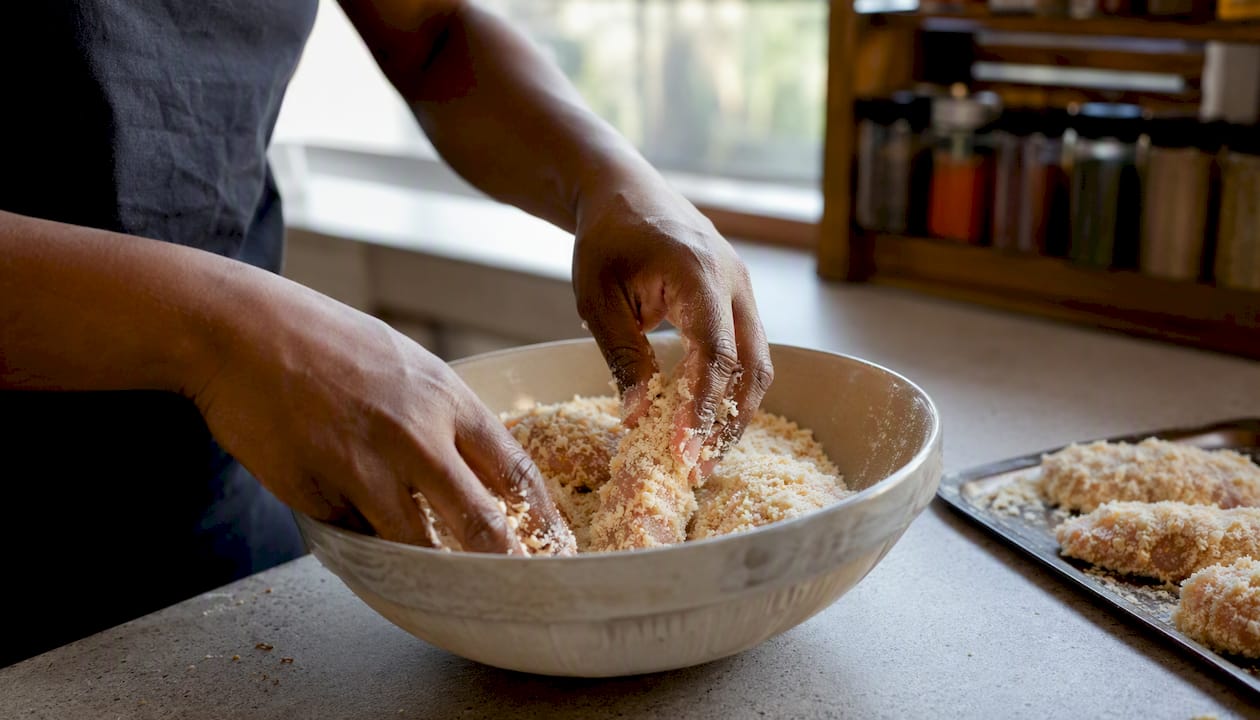
- Dredge each tender in flour, shake off the excess, dip in egg, then press firmly into the panko. Press — don’t just roll — so the crumbs compact against the surface.
- Place breaded tenders on a wire rack and let them rest for 5–10 minutes. Resting the breaded pieces before cooking is what keeps the coating from sliding off in the air fryer.
- Preheat the air fryer to 400°F for 3–5 minutes.
- Spray the basket lightly with oil. Arrange tenders in a single layer with about ½ inch of space between each one.
- Spray the tops of the tenders with oil.
- Cook at 400°F for 5 minutes, flip, spray the new top side, then cook another 5 minutes.
- Check the internal temperature at the thickest point. Pull at 165°F.
- Rest on a wire rack for 2–3 minutes before serving.
Fresh no-bread tenders
- Pat tenderloins dry, then toss in olive oil and spices (or coat in yogurt marinade).
- Preheat the air fryer to 400°F.
- Arrange in a single layer, spray lightly if using oil-only coating.
- Cook 5 minutes, flip, cook another 5 minutes. Check for 165°F.
- Rest 2–3 minutes.
Frozen tenders
No thawing needed. Preheat to 400°F, arrange frozen tenders in a single layer, and cook 12–15 minutes total, flipping once at the halfway mark. Check for 165°F before serving — frozen tenders vary in thickness, so the thermometer matters more here than with fresh.
Key rule for every method: Pull the tenders the moment the thermometer reads 165°F and rest them immediately. Carryover heat will carry the center another degree or two. Waiting until the meat “looks done” almost always means overcooked.
Quick timing and temperature reference
| Method | Temp | Total time | Flip at | Internal temp target | Notes |
|---|---|---|---|---|---|
| Fresh breaded (panko) | 400°F | about 10 min | halfway | 165°F | Spray oil before and at flip |
| Fresh no-bread | 400°F | about 10 min | halfway | 165°F | Oil or yogurt coat |
| Frozen (store-bought) | 400°F | longer cook time | halfway | 165°F | No thawing needed |
| Thick-cut strips (>1") | 400°F | longer cook time | halfway | 165°F | Add a bit more time for thickness |
Crowding the basket adds steam and cuts crispness. If tenders overlap even slightly, add 2 minutes and expect a softer crust. Thicker pieces (over 1 inch) need 2–3 extra minutes regardless of method.
400°F is the preferred starting temperature because it’s hot enough to set the panko crust quickly without drying out the interior. Lower temps (350°F or 375°F) work but produce a paler, less crunchy result and require longer cook times that can dry the meat.
Flavor variations and dipping sauce ideas
The base recipe is a blank canvas. Here are four quick pivots.
Serving ideas
Tenders work as a standalone protein, but they’re also easy to build into a full plate. Wrap them in a tortilla with slaw for a quick hot chicken wrap. Slice and lay over a Caesar salad. For a kid-friendly plate, pair with air fryer sliced potatoes and a small bowl of honey mustard. If you have leftover tenders, they make a surprisingly good filling for chicken empanadas — a technique worth borrowing from this chicken empanada recipe.
How to store and reheat leftover tenders
Storage:
- Refrigerate in an airtight container within 2 hours of cooking. They keep for up to 3–4 days.
- Freeze in a single layer on a baking sheet first, then transfer to a zip-lock bag. Frozen cooked tenders keep for up to 3 months.
- Label containers with the date. Cooked chicken left unlabeled tends to get forgotten and wasted.
Reheating:
- Air fryer (best method): 375°F for 3–4 minutes. The crust comes back close to fresh-cooked.
- Oven: 375°F for 8–10 minutes on a wire rack set over a baking sheet. Not quite as crisp as the air fryer, but far better than a microwave.
- Microwave: Avoid it for breaded tenders. The steam it generates turns the coating rubbery in under a minute.
Always reheat to an internal temperature of 165°F before eating. Discard any tenders that have been refrigerated longer than 4 days or left at room temperature for more than 2 hours.
Nutrition estimate per serving
These are approximate figures for a serving of 2–3 breaded tenders (about 4 oz cooked chicken). Use a nutrition calculator like Cronometer or MyFitnessPal for exact numbers based on your specific ingredients and portions.
- Breaded (panko) tenders: roughly 250–280 calories, 28–30g protein, 10–12g carbs, 8–10g fat per serving
- No-bread tenders: roughly 180–200 calories, 30–32g protein, 1–2g carbs, 6–8g fat per serving
Air-fried tenders use substantially less oil than deep-fried versions, which is where most of the calorie difference comes from. The protein content stays comparable either way.
Lighter swaps:
- Use chicken tenderloins (naturally leaner than breast strips cut from a thicker piece).
- Choose low-sodium panko to cut salt without changing texture.
- Use an oil mister instead of pouring oil to reduce added fat.
- Skip the double-dip if you want fewer carbs; a single coat still crisps well.
Allergen note: Standard breaded tenders contain gluten (flour, panko) and eggs. Some dipping sauces contain dairy. For a gluten-free version, use rice flour and GF panko or crushed cornflakes. For dairy-free dips, swap ranch for a tahini-lemon sauce or a simple olive oil and herb drizzle.
How we tested this recipe
Hearthlyrecipes tested panko versus regular breadcrumbs across multiple batches and found panko consistently produced a crispier, more even crust. Oil-spray timing was tested at three points: before only, after only, and before-and-after. The before-and-after spray produced the most uniformly golden result every time.
Resting breaded tenders on a wire rack for 5–10 minutes before cooking was compared against cooking immediately after breading. The rested batches showed noticeably better coating adhesion and fewer bare spots on the finished tender.
Fresh versus frozen timing was checked with an instant-read thermometer across multiple air fryer models, including 3.5-quart and 5.5-quart basket units. Smaller models ran slightly hotter and reached 165°F about 1–2 minutes faster than larger ones at the same set temperature.
Testing note: Air fryer models vary more than most cooks expect. The times in this article are reliable starting points, but your first batch is also a calibration run. Check the thermometer at the 8-minute mark on fresh tenders and adjust from there.
The single most consistent finding across all tests: the thermometer is not optional. Visual doneness cues (golden crust, no pink visible) can mislead by 2–3 minutes in either direction depending on tender thickness.
Common problems and how to fix them
Dry, rubbery chicken: Pull earlier. If the interior hits 165°F at 8 minutes, take it out at 8 minutes. Cooking to a color target instead of a temperature target is the most common cause of dry tenders.
Soggy crust: Almost always a crowding problem. Overcrowding the basket traps steam and prevents the hot circulating air from reaching the coating. Cook in batches and leave space between each tender.
Breading falling off: Three likely causes: wet chicken (skip the pat-dry step), skipping the flour layer (it’s the glue between egg and panko), or not resting the breaded tenders before cooking. Fix all three and the coating stays put.
Uneven browning: The tenders closest to the heating element brown faster. Rotate the basket or swap tenders front-to-back at the flip. On tray-style models, move pieces from the edges to the center at the halfway point.
Burnt coating, undercooked interior: Tenders are too thick for the time. Pound thick pieces to an even ½-inch thickness before breading, or add 2–3 minutes at a slightly lower temp (375°F) to let the heat penetrate without burning the outside.
Pro Tip: Before your first batch, run the air fryer empty at 400°F for 5 minutes and note how it smells and sounds. A new or recently cleaned basket may have residue that affects the first batch. A quick empty preheat clears it.
Preventative checklist:
- Pat chicken completely dry before breading or seasoning.
- Preheat the air fryer every time.
- Single layer only, ½-inch gap between tenders.
- Spray oil before cooking and at the flip.
- Rest breaded tenders 5–10 minutes before cooking.
- Check temperature at the thickest point, not the thinnest.
Why this recipe earns a permanent spot in your weeknight rotation
The air fryer chicken tender is one of those recipes that sounds simple and actually is. But there’s a gap between “simple” and “reliably good,” and most people fall into it the first few times because they trust the clock instead of the thermometer, or they crowd the basket because washing two batches feels like extra work.
What I find worth saying plainly: the no-bread version is underrated. Most recipe content pushes the breaded version because it photographs better, but a well-seasoned tenderloin cooked at 400°F with a light oil coat is genuinely delicious and takes half the prep time. If you’re cooking on a Tuesday night after work, that matters. The breaded version is worth the extra 10 minutes on a weekend or when you’re feeding kids who want something that looks like a restaurant tender.
The yogurt marinade variation is also worth trying at least once. It sounds fussy but it’s just mixing spices into yogurt and leaving the chicken in the fridge. The texture difference after even 30 minutes is real.
For readers who want to keep building out their air fryer repertoire, the air fryer chicken drumsticks recipe on Hearthlyrecipes uses the same temperature logic and is a natural next step.
More tested air fryer recipes from Hearthlyrecipes
If these tenders worked for you, the air fryer recipe collection on Hearthlyrecipes has dozens of tested recipes rated by home cooks who’ve made them on real weeknights. Every recipe includes step-by-step instructions, tested cook times, and notes on what to watch for.
For nights when you want something beyond chicken, the all recipes page covers everything from quick dinners to weekend baking. Hearthlyrecipes also has a full easy dinner collection if you’re planning a week of meals and want ideas that actually fit a busy schedule.
Useful sources
- Air Fryer Chicken Tenders Recipe | Food Network Kitchen | Food Network
- Air Fryer Chicken Tenders – Crispy & Juicy in 20 Minutes - Julie’s Eats & Treats ®
- Air Fryer Chicken Tenders Recipe - Crispy & Juicy | Kelvin’s Kitchen
- The BEST Air Fryer Chicken Strips Recipe – No Fail!
- Chicken Tenders Strips Tenderloins Air Fryer Recipe
- Crispy Golden Air Fryer Chicken Tenders - Skinnytaste
- amzn.to
FAQ
How long do you cook raw chicken tenders in an air fryer?
Cook fresh chicken tenders at 400°F for 10 minutes total, flipping once at the 5-minute mark. Always verify the internal temperature reaches 165°F at the thickest point before serving.
What temperature should you use for chicken tenders in an air fryer?
400°F is the standard starting temperature. It sets the crust quickly and cooks the interior through without drying it out. Lower temperatures work but produce a paler, softer result.
How do you get really good, crispy chicken tenders in the air fryer?
Use panko breadcrumbs, spray with oil before cooking and again at the flip, and rest breaded tenders on a wire rack for 5–10 minutes before they go into the basket. Crowding is the most common reason tenders come out soft rather than crispy.
How long do frozen chicken tenders take in an air fryer at 400°F?
Frozen tenders cook at 400°F in 12–15 minutes total. Flip once at the halfway point and check for 165°F internal temperature before serving. No thawing is needed.