The Chicken Internal Temp Every Home Cook Should Know
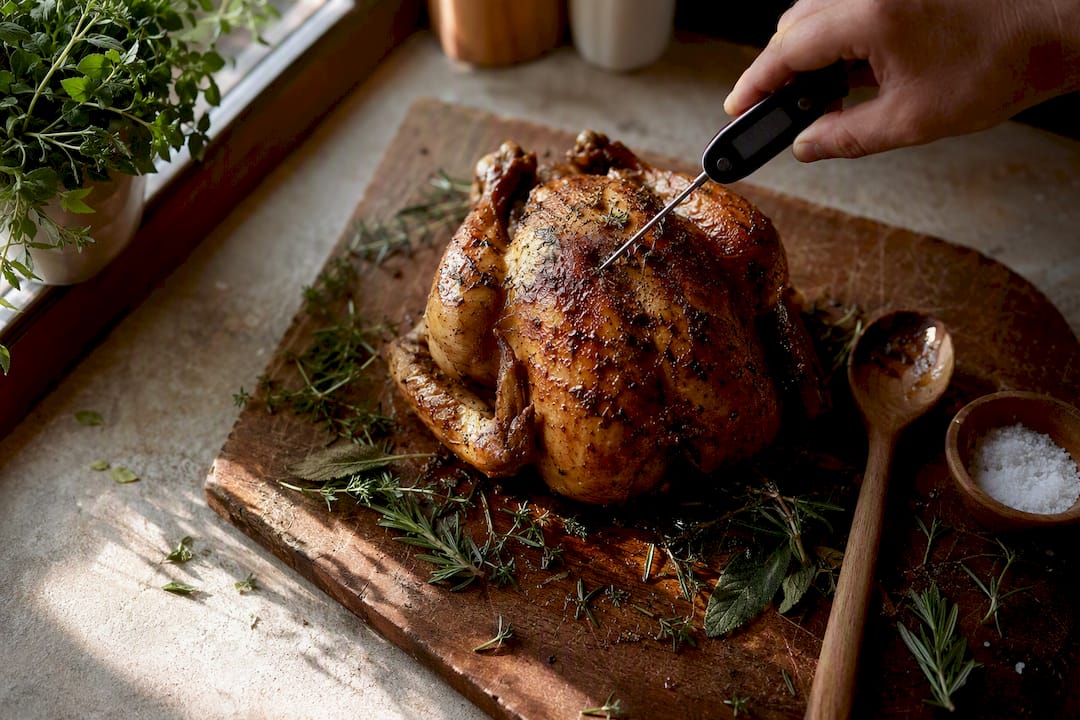
The USDA/FSIS safe minimum internal temperature for all poultry is 165°F (74°C), checked at the thickest part of the meat. That’s the rule, full stop, and it works instantly no matter which cut you’re cooking. But if you want juicier results and you know how to use a thermometer properly, the targets shift by cut and by how much patience you have.
Here’s the fast version for your kitchen:
- Chicken breast: 165°F is the safe consumer target. Experienced cooks often pull at 155–160°F and hold briefly for better texture.
- Thighs and legs: 170–175°F, where collagen breaks down into gelatin for a juicier bite.
- Wings and drumsticks: 165–175°F, depending on how crisp you want the skin.
- Whole bird: 165°F measured in the innermost thigh, wing, and thickest part of the breast.
- Ground poultry: 165°F, no exceptions.
If you’re cooking for young children, pregnant women, older adults, or anyone with a compromised immune system, stick to the straight 165°F rule every time. No hedging there.
Key Takeaways
Safe chicken temperature depends on both the number on the thermometer and where and how long that number holds at the coldest point in the meat.
| Point | Details |
|---|---|
| Default to 165°F | Use this as the safe minimum for every cut, especially when cooking for at-risk eaters. |
| Dark meat runs hotter | Thighs and legs taste better at 170–175°F, where collagen converts to gelatin. |
| Pull before target | Account for carryover, breasts rise 2–5°F, whole birds 8–12°F, after leaving the heat. |
| Probe placement matters | Avoid bone and fat, and check multiple spots on whole birds. |
| Lower temps need hold time | A reading below 165°F is only safe with a verified hold at the coldest point. |
This article is general information, not a substitute for advice from a qualified doctor. Consult a qualified healthcare professional about your own circumstances before acting on anything here.
Table of Contents
- Chicken Breast Internal Temp vs. Thigh Internal Temp: Why They Differ
- Can You Cook Chicken at a Lower Temp Than 165°F Safely?
- How to Check Chicken Temp the Right Way
- Is 145°F Safe for Chicken? Answering the Common Doneness Questions
- What Hearthly Recipes Has Learned From Testing Chicken for Doneness
- Explore More Tested Chicken Recipes at Hearthlyrecipes
- Where the Conventional Chicken Temp Advice Falls Short
- Sources
- FAQ
Chicken Breast Internal Temp vs. Thigh Internal Temp: Why They Differ
White meat and dark meat aren’t the same material, and that’s the whole reason one target temperature doesn’t fit every cut.
Chicken breast is lean, with almost no intramuscular fat to buffer moisture loss. Push it to 165°F and it’s fully safe, but the proteins have already tightened up and squeezed out juice. That’s why a lot of experienced cooks pull breast at 153–154°F, knowing carryover will carry it to 155–156°F while it rests. Serious Eats and ThermoWorks have both documented that breast held at 155°F for a short period retains noticeably more moisture than one cooked straight to 165°F. If you’re not confident in your thermometer accuracy, though, 165°F is still the right call, no apologies needed.
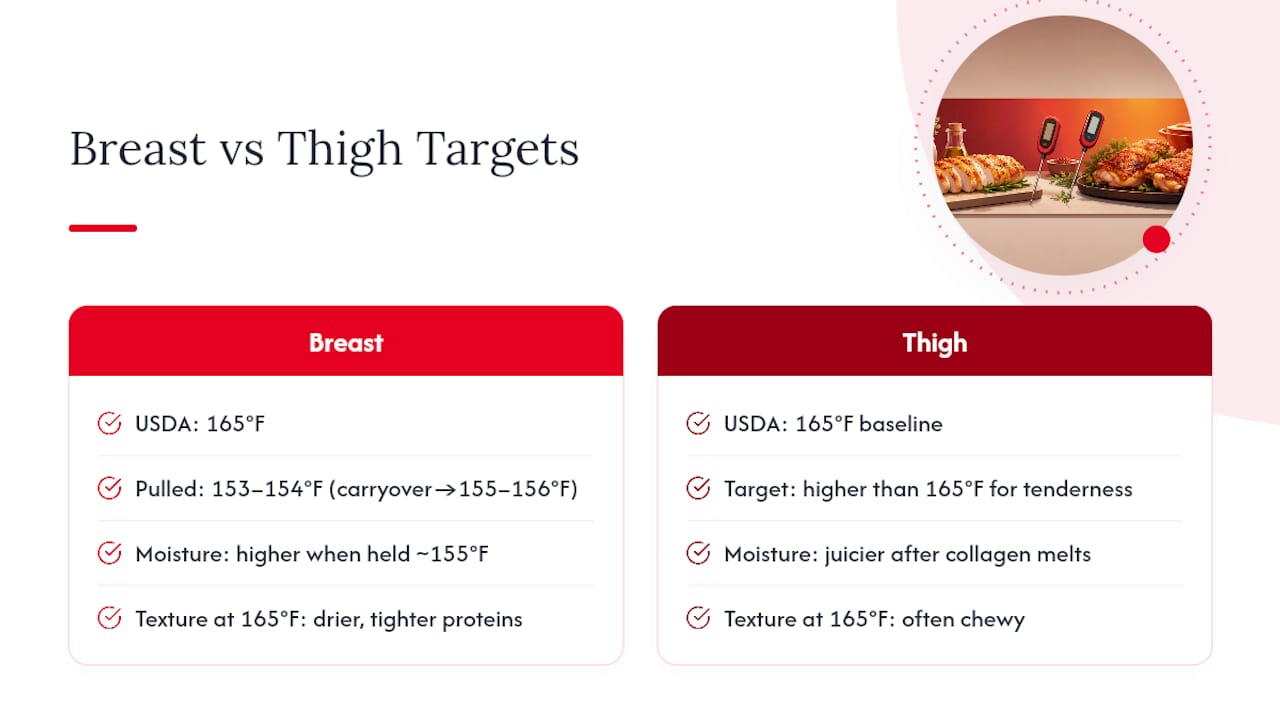
Thighs and legs play by different rules entirely. They carry more fat and connective tissue, and that tissue needs heat to convert into gelatin. Pull a thigh at 165°F and it’s often chewy rather than tender. Push it to a higher temperature where the collagen that made it tough at lower temps now makes it fall-apart juicy. Our baked boneless chicken thighs recipe leans on that higher target for a reason.
Whole birds complicate things because heat travels unevenly through bone, cavity, and skin. Check three spots: the innermost thigh, the wing joint, and the thickest part of the breast. The USDA’s 165°F rule stays the baseline here because a whole bird gives you no reliable way to guarantee every gram hit a lower hold time.
Ground poultry gets no exceptions. Grinding mixes surface bacteria throughout the meat, so 165°F is the only defensible number.
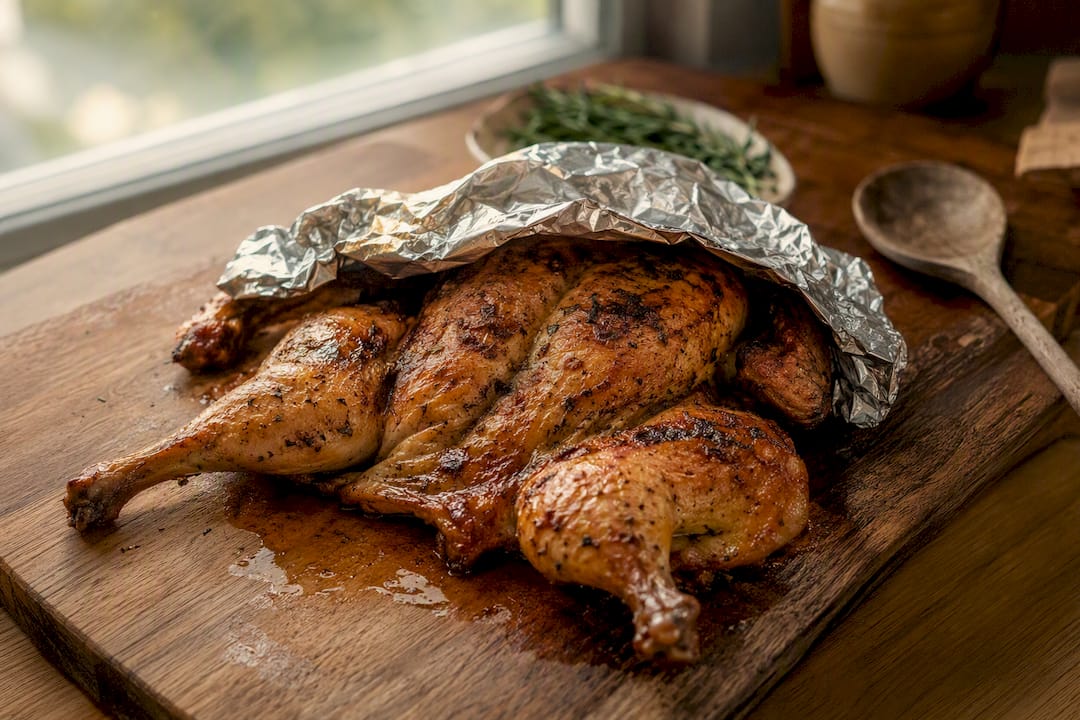
Pro Tip: If you’re roasting a spatchcocked bird, the breast and thighs finish at different rates. Pull the breast portion early and let the thighs keep cooking, or tent the breast with foil once it hits target.
Can You Cook Chicken at a Lower Temp Than 165°F Safely?
Yes, under specific conditions, and this is the part most kitchen advice skips entirely. Bacterial kill isn’t just about hitting a number. It’s about time and temperature together. This is called pasteurization, and it’s the same principle that makes sous vide chicken breast safe at temperatures well below 165°F.
The logic: holding meat at a slightly lower temperature for longer achieves the same pathogen reduction as an instant 165°F reading. Serious Eats lays out the practical equivalence: a temperature like 155°F held for a controlled window can reach the same safety threshold as a flash 165°F reading, while 150°F needs a longer hold to get there.
| Target Temp | Approximate Hold Needed |
|---|---|
| 165°F | Instant (no hold required) |
| 160°F | Instant (no hold required) |
| 155°F | A few minutes |
| 150°F | Several minutes longer still |
The catch is that this math only works if you’re actually measuring the coldest point in the meat and holding it there the entire time, not just glancing at a peak reading. In a home oven or on a grill, heat isn’t perfectly even, so guaranteeing a true hold is harder than it sounds. Sous vide setups change that calculus because the water bath keeps the whole cut at a steady temperature for as long as you want.
That’s exactly why the USDA defaults to 165°F for consumer guidance. It removes the guesswork. One reading, one number, done.
How to Check Chicken Temp the Right Way
- Pick the right thermometer. An instant-read thermometer is best for quick spot checks on individual pieces. A leave-in probe thermometer is better for whole birds or roasts you’re monitoring over time, since you can track the rise without opening the oven repeatedly.
- Probe the thickest part of the meat. Avoid touching bone or pockets of fat, both of which read differently than muscle and throw off your number.
- For whole birds, check three spots, the innermost thigh, the wing joint, and the thickest part of the breast, since these are the last areas to reach temperature.
- Pull before you hit your final target. Carryover cooking means the temperature keeps climbing after the heat source is gone. A chicken breast typically gains 2–5°F off the heat, while a large whole bird can climb 8–12°F during rest.
- Rest before cutting. Give breasts 5 minutes and whole birds 10–15 minutes so juices redistribute instead of running straight onto the cutting board.
- If a reading looks off, recheck it. Move the probe half an inch and try again in two or three spots before trusting a single number.
Pro Tip: Calibrate your thermometer in ice water (it should read 32°F) every few months. A probe that’s off by even 3–4 degrees can push you from a safe hold into undercooked territory without you knowing it.
Is 145°F Safe for Chicken? Answering the Common Doneness Questions
Color is not a safety test. Pink meat near the bone, especially in younger birds, can happen even at a fully safe 165°F because of hemoglobin trapped in the tissue. Clear juices aren’t proof of doneness either, and Foodsafety that a thermometer is the only reliable check.
Is 145°F safe for chicken? No. That number applies to specific whole cuts of beef, pork, and fish under USDA rules, not poultry. Applying it to chicken is a mix-up that circulates online but has no backing in FSIS guidance.
Is 155°F safe for chicken? Only with a proper hold time and a thermometer you trust to measure the coldest spot. Without that control, 155°F alone is not the consumer-safe number, 165°F is.
Is 180°F too much for chicken? For breast meat, yes. At 180°F, white meat is well past dry and heading toward chalky. For thighs and legs in certain slow-cooked or smoked recipes, some cooks push past 175°F intentionally for extra-tender pulled texture, but that’s a texture choice, not a safety requirement.
What Hearthly Recipes Has Learned From Testing Chicken for Doneness
Susan Scortberg’s approach to Hearthly Recipes’ chicken content stays grounded in one habit: test the temperature, don’t guess it. Recipes get checked across multiple probe points before a pull temperature makes it into a published instruction.
A few things that consistently hold up in testing:
- Probing at least two spots on any cut larger than a single breast catches uneven heating before it becomes a problem.
- Leave-in probes beat instant-read thermometers for whole birds, since you’re not opening the oven every five minutes to check.
- Recipes like our melt-in-your-mouth chicken breast and air fryer chicken drumsticks both build pull temperatures around carryover, not final oven-off readings.
The number on the thermometer only means something if you trust where you stuck it. Half the “my chicken was dry” complaints trace back to a probe that hit bone, not a bad recipe.
Explore More Tested Chicken Recipes at Hearthlyrecipes
Getting the internal temperature right is half the battle. The other half is starting with a recipe that already accounts for carryover, rest time, and cut-specific targets, so you’re not doing the math yourself every time you cook dinner. Hearthlyrecipes’ grilled BBQ chicken breast and baked chicken thighs and potatoes both build these principles into the instructions, so the pull temp is already worked out for you.
If you want more tested chicken dishes built around the same safety and texture logic, browse the full recipe vault for everything from weeknight dinners to slow-cooked comfort food.
Where the Conventional Chicken Temp Advice Falls Short
Most articles on this topic either scare readers into overcooking everything to 165°F with no nuance, or they wave at sous vide temperatures without explaining why that math doesn’t transfer cleanly to a home oven. Both approaches fail the reader.
The honest answer is that 165°F is correct, complete, and the right call for anyone who isn’t measuring carefully or cooking for someone at higher risk. But treating it as the only acceptable number ignores real food science. Time and temperature work together, and a thermometer used correctly, in the right spot, calibrated occasionally, is what actually separates a safe lower-temp hold from a guess.
What gets underrated is the thermometer itself, not the target number. A $15 probe stuck into bone will lie to you at any temperature. Prioritize calibration and placement before you worry about whether 155°F or 165°F is the “better” number. Get the measurement right first, and the temperature debate mostly resolves itself.
Sources
- Safe Minimum Internal Temperature Chart | Food Safety and Inspection Service
- Foodsafety
- Stop Overcooking Chicken: The Safer, Juicier Way to Get It Done | Serious Eats
- Chicken internal temps: everything you need to know | ThermoWorks
- The ideal chicken breast temperature: the science of juicy poultry | ThermoWorks
FAQ
Is Chicken Safe at 145°F or 165°F?
165°F is the accepted safe minimum for chicken. 145°F applies to specific whole cuts of beef, pork, and fish, not poultry.
Can You Eat Chicken at 155°F?
Only if that temperature is held at the coldest point of the meat for the required time, verified with an accurate thermometer; without that hold, 165°F remains the safe target.
Is 180°F Too High for Chicken?
For breast meat, yes, it typically turns dry and chalky. Some cooks push thighs or legs past 175°F intentionally for extra-tender pulled texture in certain recipes.
Is 157°F Safe for Chicken?
155°F can be safe with a proper hold time at the coldest spot, but it is not a standalone safe number without that hold.
Why Does My Chicken Look Pink at 165°F?
Pink coloring near the bone can happen even in fully cooked, safe chicken due to hemoglobin in the tissue; color is not a reliable safety indicator, a thermometer reading is.